NPC Registration No: 2024/319828/08

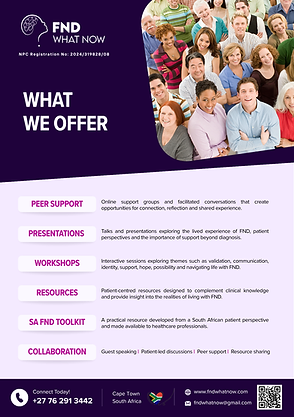
What We Offer


Lived Experience is at the Heart of What We Do!
We all have a story to share —
Ours is Functional Neurological Disorder (FND).
We recognise that a diagnosis is only one part of the journey. People may continue to need connection, information, practical support, and a safe space to explore what living with FND means for them.
Download our information sheets below!



Hover on image to download
Advancing FND Care in South Africa
Bridging the gap between local data, global evidence, and clinical tools
Functional Neurological Disorder (FND) remains under-recognised and often challenging to manage in clinical practice. We are pleased to introduce the FND – What Now? Clinician's FND Toolkit—a practical, evidence-informed resource designed to support healthcare professionals in delivering structured, function-focused care.


Developed within a South African context, this toolkit provides accessible, clinically relevant guidance with embedded links for fingertip access to further resources.
Downloaded by clinicians and patients alike!
South African Research Spotlight
Context-Specific Care is Restricted by Limited Functional Neurological Disorder Research and Resources.
The studies below highlight clinical profiles, costs, and patient experiences, underscoring challenges and opportunities for improvement.
This paper explores Functional Seizures, also known as Psychogenic Non-Epileptic Seizures (PNES)—real, involuntary episodes often mistaken for epilepsy. It calls for greater understanding and more compassionate, integrated care that recognises the complexity of patient experiences. It also highlights the importance of clear, supportive communication at diagnosis.
This study analyses the economic impact of Functional Neurological Disorder (FND) by comparing inpatient healthcare costs to other neurological conditions at Universitas Tertiary Academic Hospital. Using retrospective data from 2018–2019, it identifies FND cases and evaluates cost patterns, helping address limited insight into FND’s economic impact in South Africa.
This study examines Functional Neurological Disorders (FNDs) in a South African tertiary setting at Inkosi Albert Luthuli Central Hospital (IALCH), using a 14-year retrospective review (2003–2017) to outline patient clinical profiles, coexisting conditions, and patterns of investigation and management, contributing to the limited African data on FND. More research is needed.
Where To Next...
FND – What Now? NPC has been invited to exhibit and share the lived experience of Functional Neurological Disorder (FND) at the 2026 Biological Psychiatry Congress. In collaboration with the Departments of Psychiatry and Psychology at Stellenbosch University, we aim to bridge the gap between clinical knowledge and patient experience.
